Red Dust and Open Roads: Safety Compliance in the Australian Outback
There is nothing quite like the Australian Outback. Whether you are trekking through the Red Centre, navigating the corrugated tracks of the Kimberley, or simply finding a quiet spot off the grid in Western Queensland, the freedom of the open road is what we live for. But as any seasoned traveller will tell you, the Outback is as unforgiving as it is beautiful.
When you’re towing a 3.5-tonne caravan across thousands of kilometres of heat, dust, and vibration, your gear is the only thing standing between a dream trip and a roadside disaster. In Australia, "near enough" isn't good enough: especially when it comes to trailer safety chain laws.
If you aren't across the latest requirements for AS 2741-2002 shackle compliance, or if you’re unclear on the difference between your trailer’s ATM and your vehicle’s tow capacity/GCM limits, this guide is for you. Let’s get your rig sorted before you hit the blacktop.
Primary towing compliance reference (Australia): VSB 1 (Vehicle Standards Bulletin 1), alongside AS 2741-2002 (shackles).
The Numbers Game: Understanding ATM vs Tow Capacity
Before we even look at a shackle, we need to understand the weight of the setup. In the world of Australian towing, acronyms are everywhere, and getting them wrong can lead to fines, voided insurance, or worse.
Aggregate Trailer Mass (ATM)
The ATM is the total weight of your trailer or caravan when it is fully loaded and uncoupled from the tow vehicle. This includes your water tanks (full), gas bottles, food, gear, and the weight of the caravan itself. If you are towing a modern off-road caravan, you are likely pushing the 3.5-tonne limit.
For shackle compliance in Australia, ATM is the primary legal reference for the trailer. It is the key number you use when matching your safety chains and shackles to your rig.
Tow Capacity and GCM
Your tow vehicle has its own legal limits. These are separate from the trailer’s ATM.
- Tow capacity is the maximum trailer weight your vehicle is allowed to tow, as specified by the manufacturer.
- GCM (Gross Combination Mass) is the maximum allowed mass of the loaded tow vehicle plus the loaded trailer combined.
So here’s the simple version:
- ATM = trailer compliance reference
- Tow capacity/GCM = vehicle compliance limits
If your caravan’s ATM is 3.5 tonnes but your vehicle can only legally tow 3 tonnes, you are non-compliant. Same story if your combined loaded vehicle-and-trailer mass exceeds GCM.
For most heavy-duty setups in Australia, the 3.5-tonne mark is the "magic number." That is also the upper limit for stainless steel towing shackles like Snap-D. Above that, different hardware rules apply.
Understanding VSB 1 + AS 2741-2002: What Actually Matters for Towing
In Australia, the key reference for trailer towing hardware (including how safety chains are attached) is VSB 1 (Vehicle Standards Bulletin 1), with AS 2741-2002 as the relevant standard for shackles.
Here’s the practical takeaway for caravans and trailers:
- ATM is the legal determinant for towing shackle compliance: For trailer towing in Australia, the trailer’s ATM is the number that matters when selecting a compliant shackle.
- Each individual shackle must match the full ATM: If your trailer is 3.5T ATM, then each shackle used on the safety chains must be rated to 3.5T ATM. Not half. Not shared across two chains.
- 3.5T ATM is the stainless limit: 304 stainless steel shackles like Snap-D are compliant only for trailers up to 3.5T ATM. For trailers over 3.5T ATM, stainless steel shackles are not compliant for this application and Grade 80 hardware is required.
- Markings you want to see: A compliant towing shackle should be permanently marked with the manufacturer’s mark (e.g. Snap-D) and a clear ATM towing rating you can match to your rig.
- Breaking load safety factor (VSB 1): As a rule, towing components used to connect safety chains should have a minimum breaking load of 1.5 times the trailer’s ATM.

Why Your Shackle Matters at 3.5 Tonnes
If your caravan weighs 3.5 tonnes, those safety chains are your "last line of defence." If the hitch fails, the chains catch the drawbar. The shackle is the literal "weak link" in that chain if it isn't up to the task.
Under VSB 1 (and in line with accepted practice for chain attachments), for trailers/caravans over 2.5T ATM, you need dual safety chains and you must connect them with TWO shackles (one per chain).
A common mistake is using one big shackle to connect both chains. That’s a compliance fail. Each chain needs its own dedicated shackle, and each individual shackle must be rated for the trailer’s full ATM.
Stainless vs. Galvanised
While many old-school towers swear by galvanised steel, Snap-D’s 304 Stainless Steel shackles have changed the game. Our shackles are tested and rated, offering excellent corrosion resistance: perfect for beach launches or the humid conditions of the Top End.
But here’s the legal line in the sand: 304 stainless steel towing shackles like Snap-D are only compliant for trailers up to 3.5T ATM. If your trailer is over 3.5T ATM, you need Grade 80 hardware for compliance.
The Snap-D Difference: No More "Frankenstein" Shackles
We have all seen them: the rusted-on shackles that require a shifter and a can of WD-40 to undo, or the "Frankenstein" setups where a shackle has been forced through a hole it was never meant to fit.
At Snap-D, we designed our hardware specifically to solve the frustrations of Australian towers. Our half-turn shackles feature a patented captive pin and retaining clip system built for high-vibration towing.
- Quick Connect: Push it in, half a turn, job’s done.
- Captive Pin (can’t be lost): The spring-loaded pin stays attached to the shackle body when open. No more dropping pins in the red dust or losing them in the long grass.
- Retaining Clips (anti-vibration + anti-theft): Our retaining clips (15mm IDA / 20mm ODA) help stop the shackle/pin system from backing out or rattling loose on corrugations, and they also make it harder for opportunistic thieves to remove your shackles.
- Certified ratings: Every shackle is laser-engraved with its ATM towing rating and manufacturer mark, so you can show any roadside inspector exactly why your rig is legal.
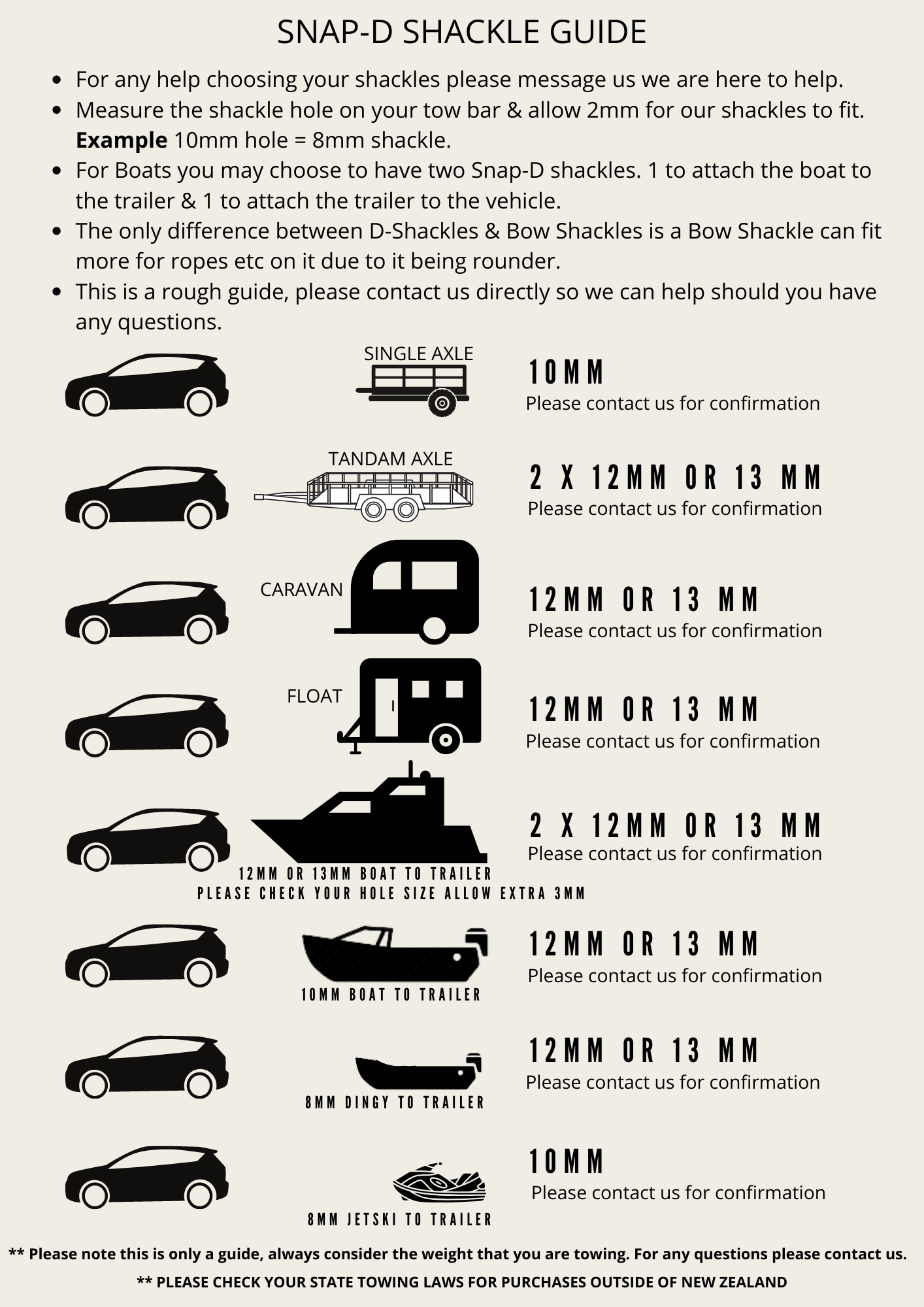
Outback Ready Checklist
Before you head out on your next adventure, run through this compliance checklist to ensure you’re meeting trailer safety chain laws in Australia:
- Check the ATM: Ensure your caravan's loaded weight doesn't exceed its ATM plate.
- Dual Chains: For anything over 2.5 tonnes, ensure you have two chains (welded at the trailer end).
- Rated Shackles: Are your shackles marked with the manufacturer’s mark (best ones are marked Snap-D) and an ATM towing rating you can match to your rig? If they’re blank, don’t assume they’re legal for towing. Remember: each individual shackle must be rated for the full ATM of the trailer.
- Pin Security (anti-vibration): Corrugations are brutal. Snap-D’s spring-loaded captive pin plus retaining clips (15mm IDA / 20mm ODA) are designed to help prevent pins vibrating loose.
- Breaking load check (VSB 1): Your chain connection hardware should have a minimum breaking load of 1.5× your trailer’s ATM.
- Condition Check: Inspect for any "necking" (stretching) of the shackle or signs of damage/corrosion that might compromise structural integrity.
Snap-D Australia: Compliance Cheat Sheet (External Summary)
| What you’re trying to comply with | The plain-English rule (Australia) | What to check on your rig |
|---|---|---|
| Primary authority | VSB 1 is the main reference for trailer towing compliance | Use VSB 1 as your go-to, with AS 2741-2002 as the relevant shackle standard |
| Trailer weight term | ATM (Aggregate Trailer Mass) = trailer/caravan max mass when uncoupled and loaded | Read your ATM plate and don’t guess |
| Tow vehicle limit | Tow capacity / GCM = your vehicle’s legal towing and combined-mass limits | Your vehicle must be legally able to tow the trailer and stay within GCM |
| Shackles on safety chains | For caravans/trailers >2.5T ATM: dual safety chains and TWO shackles (one per chain) | One shackle per chain—don’t bundle both chains into one shackle |
| What determines shackle towing compliance (Snap-D stainless) | ATM is the legal determinant for towing shackle selection | Look for Snap-D marking + ATM towing rating |
| Rating requirement per shackle | Each individual shackle must be rated for the trailer’s full ATM | If the trailer is 3.5T ATM, each shackle must be 3.5T ATM rated |
| Stainless steel limit | 304 stainless steel towing shackles are compliant only up to 3.5T ATM | If the trailer is over 3.5T ATM, use Grade 80 hardware instead |
| Minimum safety factor (VSB 1) | Hardware used to connect chains should have breaking load ≥ 1.5× ATM | Choose rated, certified towing shackles—not generic hardware |
| Anti-vibration safety | Pins can work loose on corrugations if not secured | Use a captive pin design and retaining clips (Snap-D clips: 15mm IDA / 20mm ODA) |
Conclusion
Towing in the Australian Outback is one of the most rewarding experiences you can have, but it demands respect for the gear you use. By following VSB 1, choosing correctly ATM-rated shackles, and understanding the difference between your trailer’s ATM and your vehicle’s tow capacity/GCM limits, you aren't just staying legal: you're protecting your family and your investment.
Don’t let a $30 piece of hardware ruin a $100,000 caravan trip. Invest in quality, rated equipment that is built for the task.
Ready to upgrade your towing setup? Explore our full range of transport-compliant shackles or contact us if you have questions about which size is right for your rig.
Happy Towing, Legends!
Paul Bennett
Snap-D Australia
Also in Information Centre


Towing Terminology 101: ATM, GTM, and TBM Explained for Boaties
Confused by ATM, GTM and TBM? Learn the difference, understand Australian towing compliance, and choose the correct Snap-D shackle for your trailer.


Follow