How to Choose the Right ATM-Rated Shackle for Your Caravan (2T vs 3.5T)
When you’re prepping for a lap around Australia or even just a weekend run to the coast, the checklist is usually a mile long. Tyres, water, hitch height, mirrors… done. But there’s one small bit of gear that can make or break a worst‑case moment: the safety chain shackle.
If your coupling ever lets go, your safety chains (and the shackles joining them to the towbar) are what keep the van attached long enough to get you stopped safely. So this isn’t “what fits through the link” — it’s compliance, engineering, and keeping everyone on the road out of strife.
This guide breaks down what to look for in an ATM-rated shackle for common caravan sizes (2T and 3.5T), why ATM is the number that matters for towing compliance, and the simple over 2.5T = dual chain rule.
AS 2741-2002 First: The Compliance Reference That Matters
If you only remember one standard for shackles in Australia, make it AS 2741-2002 (Shackles). It’s the benchmark for what a “rated” shackle is meant to be, including things like design, testing and marking requirements.
You’ll also hear AS 4177 mentioned in towing conversations because it covers tow couplings and towing components. Bottom line: if you’re choosing shackles for caravan safety chains, stay aligned with AS 2741, and keep the rest of your tow hardware in the same “compliance mindset”.
ATM vs WLL (Simple Version)
This is where people get tied in knots, so here’s the plain-English version:
- ATM (Aggregate Trailer Mass): Your caravan’s maximum mass when it’s not hitched (van + all your gear). This is the number printed on the compliance plate and the one you’ll see referenced in towing rules for chains.
- WLL (Working Load Limit): A lifting term used for hoisting gear. It is not the towing number you should use to choose a safety chain shackle for a trailer.
So which one do you use?
Use ATM. For towing compliance, ATM is the relevant rating reference when matching your trailer to a shackle.
The big rule: each individual shackle must be rated to the FULL ATM of the trailer.
So if your trailer is 3.5T ATM and requires two safety chains, you still need two shackles each rated to 3.5T ATM — not two smaller shackles that “add up” to 3.5T.
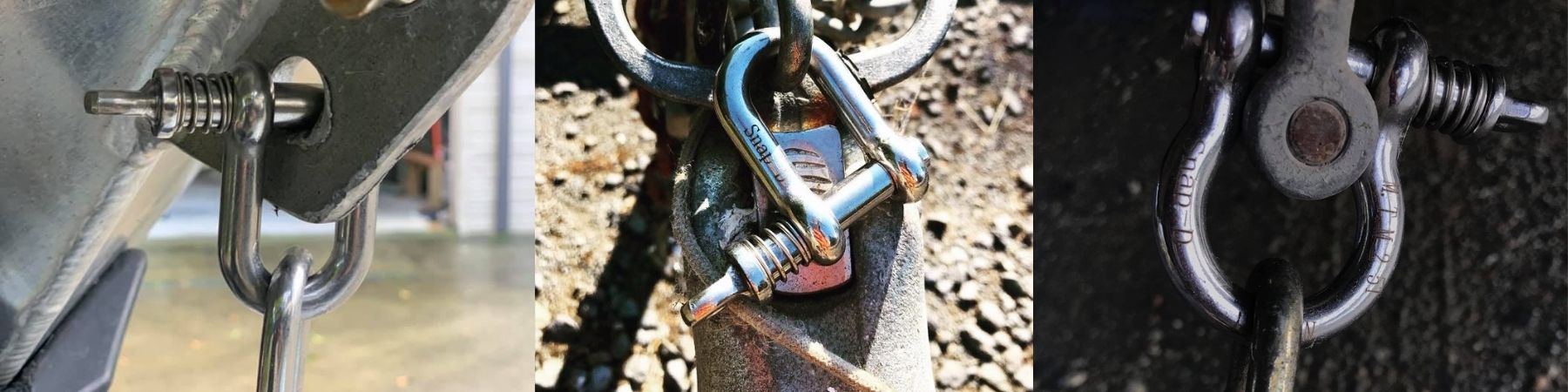
What to Look For on a Towing Shackle (AS 2741-2002 Style)
A proper towing shackle isn’t just “stainless” or “heavy duty”. For roadside confidence and real-world safety, you want:
- Permanent markings (manufacturer ID and relevant ratings/markings per AS 2741-2002)
- A known, tested rating matched to your trailer’s full ATM
- A design that won’t loosen or seize at the worst time
Snap‑D’s whole thing is making the “right” option also the easy option: Push it in, half a turn, job's done.
The 2.5T Dual Chain Rule (Explained Simply)
Here’s the rule most people miss, and it’s dead simple:
- If your caravan/trailer is 2.5T ATM or under, you’ll typically see a single safety chain setup (vehicle and trailer dependent).
- If your caravan/trailer is over 2.5T ATM, you need two safety chains.
And this is the key bit people muck up:
Two chains means two connection points — so you run TWO shackles. One shackle per chain.
Not “two chains into one shackle”. Keep it simple and keep it compliant.
2T Caravan (Around 2000kg ATM): What Size Snap‑D?
A 2T van is super common — single axle caravans, campers, and plenty of mid-size tourers. Even at 2T, the forces involved in a sudden load event are no joke.
Practical checklist:
- Confirm your ATM on the compliance plate
- Check your towbar/shackle hole diameter (fitment matters)
- Choose a shackle rated to the full ATM of the trailer
Snap‑D pick: 10mm D‑Shackle
3.5T Caravan (3500kg ATM): What Changes?
3.5T is the big, common ceiling for a lot of modern off-road caravans. At this weight, you’re automatically in the “do it properly” zone.
What changes in practice:
- You’re over 2.5T ATM → you run two safety chains
- Two safety chains → you run two shackles (one per chain)
- Each individual shackle must be rated to the full ATM of the trailer
Compliant Snap‑D setups (run as a pair):
A lot of caravanners prefer the bow shape at the hitch because it gives the chain a bit more room to move without binding.
Anti-Theft Retention Clips (15mm IDA / 20mm ODA)
This is the little add-on that saves a lot of swearing.
Snap‑D retention clips are designed to sit on the shackle and retain it at the towbar connection point, so when you unhook chains at camp (or at home), your shackles don’t drop in the dirt, bounce down the track, or get “mysteriously relocated”.
Why they’re worth it:
- Stops accidental loss: The clip helps keep the shackle where it belongs, instead of falling off when chains are removed.
- Adds an anti-theft layer: It’s not a bank vault, but it does make it harder for someone to casually walk past and pinch your shackles.
- Correct size matters: Snap‑D clips are 15mm IDA / 20mm ODA — made to suit the Snap‑D setup properly.
If you tow regularly, these clips are one of those “cheap insurance” bits of gear you’ll be glad you fitted.
Why Snap‑D is Different (In the Ways That Actually Matter)
304 Stainless Steel (No Rusty Drama)
Traditional galvanised shackles can rust, seize, and generally become a pain over time — especially if you do coastal runs or beach launches. Snap‑D shackles are 304 stainless steel, so they stay clean and usable.
Important: stainless steel shackles are for trailers up to 3.5T ATM only. For anything over 3.5T ATM, Grade 80 is required.
Captive, Spring-Loaded Half‑Turn Pin (No Lost Pins)
No more winding a pin out, dropping it in the grass, then spending 10 minutes with a phone torch.
Snap‑D uses a spring‑loaded, half‑turn captive pin system — the pin is retained, so it can’t be lost, and it’s fast to operate.
Common Stuff-Ups (Easy Fixes)
- Buying “hardware store” shackles: If it’s not a properly rated shackle built to AS 2741 expectations, it doesn’t belong on safety chains.
- Trying to run two chains into one shackle (over 2.5T): Don’t. One chain = one shackle.
- Ignoring fitment: Measure the towbar holes and chain link size so you’re not forcing gear or chewing it out over time.
Wrap Up
Pick your shackle based on your caravan ATM, and keep the setup simple:
- Up to 2.5T ATM: commonly single chain (setup dependent)
- Over 2.5T ATM: two chains + two shackles (one per chain)
- Each individual shackle must be rated to the full ATM of the trailer
- 304 stainless steel shackles are for trailers up to 3.5T ATM only
- Over 3.5T ATM: Grade 80 is required
- WLL is a lifting term — for towing, ATM is the number that matters
And if you’re sick of seized pins and fiddly hardware: Push it in, half a turn, job's done.
Want to sanity-check your setup? Have a look at the range on Snap‑D Australia: https://snapd.au
CTA: "Check your ratings! Link in bio for our sizing guide."
Also in Information Centre


Towing Terminology 101: ATM, GTM, and TBM Explained for Boaties
Confused by ATM, GTM and TBM? Learn the difference, understand Australian towing compliance, and choose the correct Snap-D shackle for your trailer.


Follow