Are You Making These Common Safety Chain Compliance Mistakes? (The 2026 Audit)
Alright legends, let’s get into it...
If you’re reading this, you probably love the freedom of the open road, the smell of salt air, or the red dust of the outback. But if you’re still using that rusty old shackle you found at the bottom of a toolbox, or worse, a cheap zinc-plated one from the local hardware shop, you’re basically towing a ticking legal time bomb.
It’s 2026, and Australian towing laws aren't getting any more relaxed. Whether you’re pulling a boat, a caravan, or a heavy-duty work trailer, compliance is the difference between a smooth trip and a massive fine (or a trailer overtaking you on the highway).
Most people think they’re doing the right thing, but they’re falling into the same five traps. Let’s run the 2026 Compliance Audit on your setup right now.
1. The "No Splitting" Rule: Don’t Do the Maths
This is the single biggest mistake we see at boat ramps and campsites across Australia.
Let’s say you’ve got a trailer with a 3.5T (3,500kg) ATM. You’ve got two safety chains (which is legally required for anything over 2.5T, by the way). A lot of blokes think, "Right, 3.5 tonnes split across two chains... I’ll just get two shackles rated at 1.75 tonnes each. Easy."
Wrong.
In a breakaway situation, you cannot guarantee that the load will be perfectly balanced between those two chains. If one chain takes the initial jolt, that single shackle has to hold the entire weight of the trailer.
The Rule: Each individual shackle must be rated for the full ATM of the trailer. If your caravan is 3.5T, you need two shackles, each rated for at least 3.5T. No splitting, no shortcuts.
2. MTM vs ATM: Know Your Acronyms
We use ATM (Aggregate Towing Mass) for certification in Australia. If you look at the actual Snap-D shackle body, you’ll see ATM stamped on it to match the trailer’s compliance plate.
But don't let the alphabet soup confuse you. For the purpose of selecting your shackles:
- ATM is the total weight of your trailer and everything on it when it’s not hitched up.
- MTM (Maximum Towing Mass) is the certification rating we use to show how much trailer weight the shackle is approved to tow.
In practice, the simple rule is this: match the ATM on your trailer plate with a Snap-D shackle stamped ATM to suit. For example, if you’re towing a 2.5T boat, our 12mm D Shackle rated at 2500kg ATM is your perfect match.

3. The 3.5T Hard Border: Stainless vs Grade 80
We love stainless steel. It’s tough, it doesn’t rust, and it looks mint. For the vast majority of Aussie trailers: your weekend boats, trade trailers, and mid-sized caravans: 304 stainless steel is the gold standard.
But there may be a limit.
Under Australian regulations (VSB 1), stainless steel shackles are perfect and 100% legal for trailers up to 3.5T ATM.
Once you cross that 3.5T threshold: we’re talking big off-road caravans or heavy machinery trailers: the rules may change, depending on your State/Territory. Anything over 3.5T may require Grade 80 hardware (often referred to as Herc-Alloy). If you’re pulling a 4.5T beast, you need to step up to the 17mm D Shackle or 19mm Bow Shackle which are rated for the job, but always check your specific State/Territories latest Grade 80 requirements for the heavy stuff.
4. If It Isn’t Stamped, It Isn’t Rated
"It looks strong enough" is not a legal defence.
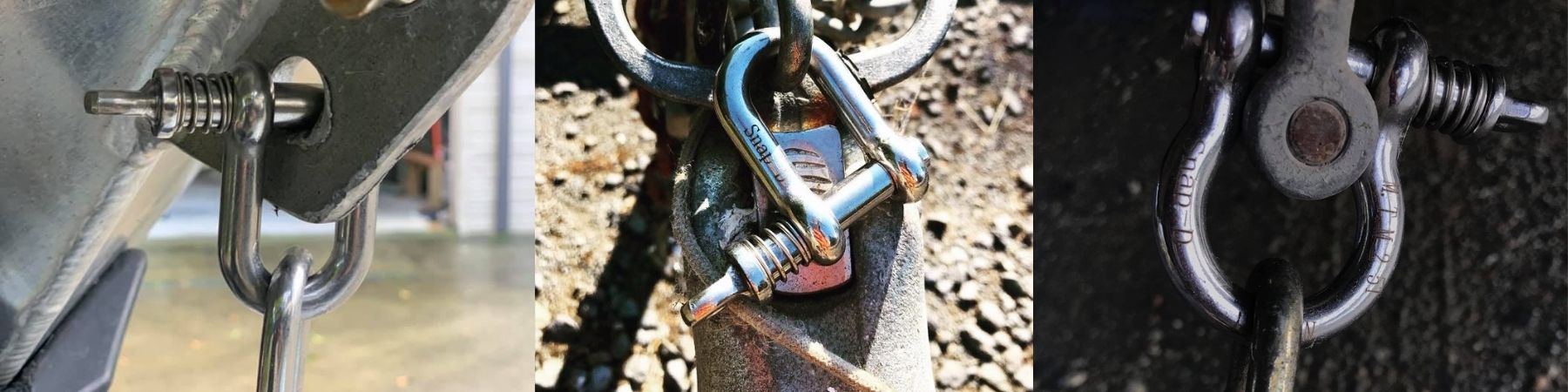
A common mistake is using "commercial" or "hardware" shackles. These are fine for hanging a gate or securing a dog lead, but they have zero place on a safety chain. If a shackle doesn't have its rating permanently stamped into the body, a transport officer will treat it as having a rating of zero.
When you’re doing your audit, look for these marks:
- ATM: The towing rating stamped on the shackle body.
- Manufacturer’s Mark: Like the "Snap-D" stamp on all our gear.
If your current shackle is a smooth, blank piece of mystery metal, ditch it today.
5. The "Weakest Link" Mismatch
You can have the strongest chain in the world, but if you connect it with a weak shackle, you have a weak system. Conversely, putting a 4.5T shackle on a chain rated for 1 tonne doesn't make your trailer safe.
Everything in your connection: the chain, the shackle, and the tow bar: must be rated to handle the ATM of the trailer.
Pro Tip: For trailers over 2.5T, you need two chains. These chains must be crossed under the drawbar to create a "cradle." If the hitch fails, the cradle catches the drawbar and prevents it from digging into the bitumen and flipping your rig.
The Snap-D Advantage: Why We’re Better Than "Old Tech"
Let’s be honest: traditional screw-in shackles are a pain. They seize up, the pins vibrate loose and go missing, and you end up needing a pair of pliers just to go for a surf.
We designed Snap-D to solve all of that.
- Push In. Half a Turn. Job Done: Our patented half-turn design is the fastest on the market. No more endless screwing.
- Captive Pin: The pin stays with the shackle. You can’t lose it in the sand, and it can’t vibrate out on a corrugated road.
- 304 Stainless Steel: No more rust-seized pins. Ever.
- Compliance Guaranteed: Every Snap-D shackle is load tested, certified, and stamped for Australian and New Zealand towing.
Ready to Upgrade Your Hitch?
Don't wait for a roadside inspection or a "near miss" to fix your compliance. If your shackles aren't rated, aren't stamped, or are just a hassle to use, it's time to switch to the world's best towing shackle.
Shop the Full Snap-D Range Here
Get into it, legends!
Cheers,
Gov
Also in Information Centre


Towing Terminology 101: ATM, GTM, and TBM Explained for Boaties
Confused by ATM, GTM and TBM? Learn the difference, understand Australian towing compliance, and choose the correct Snap-D shackle for your trailer.


Follow